Live Edge Dining Table: Woods, Sizes & Bespoke Options
Updated 16 October 2026
A live edge dining table is the kind of piece that becomes the centre of a home: the place for long Sunday lunches, homework, board games and late conversations. Because every slab is unique, choosing one is less like picking from a catalogue and more like choosing a character. This buyer’s guide covers the decisions that matter – species, size, base, finish and budget – so you end up with a table that fits your room and lasts for generations.
If you are new to natural-edged timber, start with our live edge wood guide, which explains how slabs are milled, dried and stabilised. Here we focus on the dining room itself.
Why choose a live edge dining table?
- One of a kind. No other table will share its grain, edge profile or knots.
- Solid and repairable. A thick hardwood top can be sanded and refinished many times over its life.
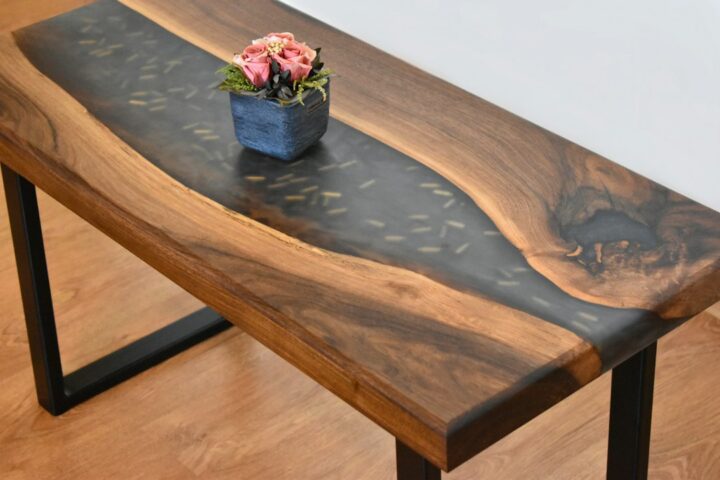
- Works with many styles. Paired with slim steel legs it feels modern; with a chunky timber trestle it feels farmhouse; with a resin river it becomes a statement.
- Natural material. Many slabs come from storm-felled, urban or sustainably managed trees.
The trade-offs are worth knowing too: solid slabs are heavy, they move slightly with the seasons, and good ones are not cheap. A well-made table accounts for all three.
Choosing the wood
The species sets the colour, the hardness and much of the price. For a dining room table that will see daily use, hardness and stability matter as much as looks.
| Species | Look | Wear resistance | Notes |
|---|---|---|---|
| Walnut | Dark chocolate with pale sapwood edge | Good | The most requested; superb with black steel or resin |
| Oak | Honey to mid-brown, ray fleck | Very good | Hard-wearing family choice; popular in the UK |
| Elm | Warm brown, wild grain | Good | Dramatic edges, often used for river designs |
| Ash | Pale, bold growth rings | Very good | Light, Scandinavian look |
| Maple / sycamore | Very pale, sometimes spalted | Very good | Contemporary, bright rooms |
A live edge oak dining table is a classic choice in the UK because European oak is locally available, tough and ages to a lovely golden tone. Walnut gives a richer, darker look – see our walnut epoxy table page for how it pairs with clear and coloured resin.
Single slab, bookmatched or river?
- Single slab – the purest look, but wide slabs (900 mm plus) are scarce and expensive.
- Bookmatched pair – two consecutive slabs joined down the middle with mirrored grain. Easier to source in dining widths.
- Resin river – two slabs with the live edges facing inwards and a resin channel between them. Our live edge epoxy table and river table guides cover this style in depth, and the epoxy dining table page shows how it scales up for seating.
Getting the size right
Allow roughly 600 mm (24 in) of table length per seated person, and at least 900 mm (36 in) of clearance between the table edge and walls or furniture so chairs can slide out. Remember that a natural edge varies in width along its length – measure the narrowest point, not the widest.
| Seats | Typical length | Typical width |
|---|---|---|
| 4 | 1,200–1,500 mm (4–5 ft) | 800–900 mm |
| 6 | 1,800–2,000 mm (6–6.5 ft) | 900–1,000 mm |
| 8 | 2,200–2,400 mm (7–8 ft) | 950–1,050 mm |
| 10 | 2,700–3,000 mm (9–10 ft) | 1,000–1,100 mm |
Standard dining height is about 740–760 mm (29–30 in) to the top surface. Thickness is a balance: 40–50 mm feels solid without being overpowering, while 60–75 mm creates a chunky, dramatic edge but adds weight. A 2 m oak top 50 mm thick can easily weigh over 60 kg before the base is added, so think about stairs and doorways before you order.
For a live edge kitchen table in a smaller room, a shorter slab with one natural edge and one straight edge pushed against a bench or wall saves space while keeping the character.
Choosing a base
The base affects legroom, stability and style as much as the top does.
- Trapezoid or U-shaped steel legs – clean and modern, positioned near the ends for maximum legroom.
- X-frame steel or timber – sculptural, very stable, but check the cross members do not clash with chair legs.
- Central pedestal or spider base – frees up the corners so you can squeeze in extra chairs; needs a heavy foot to stay stable.
- Timber trestle – traditional and warm, ideal with oak or elm.
- Waterfall end – the slab folds down to the floor at one or both ends, using mitred sections of the same board.
Whatever the style, the top should be fixed with slotted holes, figure-eight fasteners or Z-clips so it can expand and contract across its width. Rigid fixings are the most common cause of cracks in solid tops.
Finishes for a dining surface
| Finish | Pros | Cons |
|---|---|---|
| Hardwax oil | Natural feel, easy spot repair | Needs re-oiling every 1–3 years; less resistant to standing liquids |
| Polyurethane / lacquer | Tough, easy to wipe clean | Scratches and wear are harder to repair invisibly |
| Epoxy flood coat | Glassy depth, seals cracks and voids | Not highly heat-resistant; scratches show on gloss |
Families with young children often prefer a durable film finish; people who love the feel of timber usually choose hardwax oil. For a resin top, our table top epoxy guide explains how flood coats are applied and cured. Whatever you choose, always use mats for hot dishes – no finish loves a pan straight from the oven.
Live edge dining table prices in the UK and US
Prices vary with species, width, thickness, base and finish, so treat these as broad, typical ranges:
- Simple oak or ash top on steel legs, 4–6 seats – typically £1,500–£3,000 ($1,800–$3,800).
- Walnut or wide single slab, 6–8 seats – typically £3,000–£6,000 ($3,500–$7,500).
- Resin river or bookmatched statement table – typically £3,500–£8,000+ ($4,000–$10,000+), depending on size and resin volume.
- DIY from a rough slab – typically £400–£1,500 ($500–$2,000) in materials, plus tools and many hours of flattening and finishing.
To compare ready-made and commissioned options, see our epoxy tables for sale and river tables for sale buying guides.
Buyer’s checklist
- Ask about drying. The slab should be at around 8–12% moisture content. Ask how it was dried and request a meter reading.
- Look underneath. A quality table is finished on both faces to slow uneven moisture exchange.
- Check flatness. Sight along the top; there should be no rocking or obvious cup.
- Inspect cracks and voids. They should be stabilised with resin or butterfly keys, not left open.
- Confirm the fixings. Ask how the top attaches to the base to allow movement.
- Plan delivery. Measure doorways, stairs and lift sizes; check whether the base is removable.
- Ask about aftercare. A good maker will tell you exactly how to clean and refresh the finish.
Bespoke or off the shelf?
Off-the-shelf tables are quicker and often cheaper, but sizes are fixed and you may not see the actual slab before it arrives. A bespoke commission lets you choose the exact board, set the length and width for your room, pick the base and finish, and add details such as a resin river, filled knots or even embedded lighting. Our custom epoxy tables page explains how a commission typically works, from slab selection to delivery.
If you are weighing up species, the US Forest Products Laboratory’s Wood Handbook chapter on Characteristics and Availability of Commercially Important Woods describes walnut, oak, maple, elm and many others, including their colour, grain, hardness and typical uses.
Watch it being made
See one of our tables come together in the workshop: a nebula resin top with fibre optic stars, from the first pour to the lights going on.
Resin art nebula resin table with fibre optic art. More builds on the Go Bespoke YouTube channel.
Frequently asked questions
Are live edge dining tables practical for everyday use?
Yes, provided the slab is properly dried, stabilised and finished. Choose a hard species such as oak, walnut or ash, use mats for hot dishes, and wipe up spills promptly.
How thick should a live edge dining room table be?
Most sit between 40 and 60 mm. Thinner tops can look underwhelming at dining sizes, while very thick slabs add significant weight and cost.
What is the best wood for a live edge kitchen table?
Oak is hard-wearing and affordable, walnut offers a rich dark tone, and ash or maple suit lighter rooms. Hardness and a durable finish matter more in a busy kitchen than species alone.
Do live edge tables crack over time?
Small checks can appear if the wood was not fully dried or the room is very dry. A correctly dried slab, flexible fixings and steady humidity of roughly 40–60% keep movement to a minimum, and any hairline cracks can usually be filled.
How long does a bespoke table take to make?
Typically several weeks, depending on slab availability, drying, resin curing times and finish. Resin river tables take longer because deep pours need days to cure before flattening.
Ready to design a table around your room and your family? Contact Go Bespoke to discuss species, sizes and base options for a bespoke live edge commission built in our London workshop.