Live Edge Epoxy Table
Updated 9 October 2026
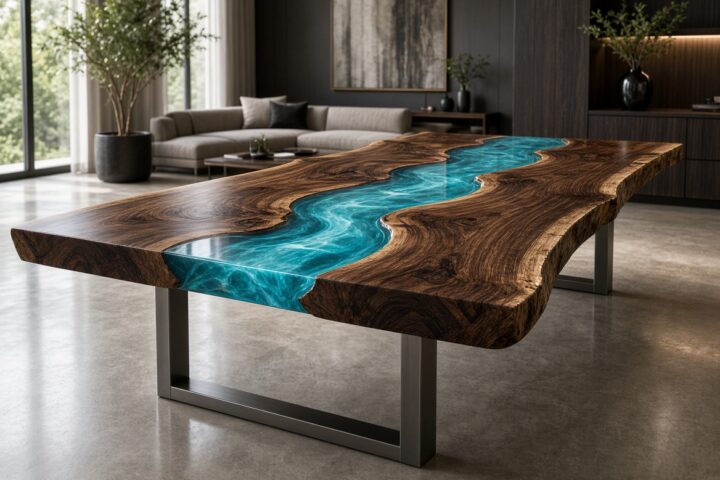
A live edge epoxy table keeps the natural outer edge of the tree exactly as it grew, then uses epoxy resin to frame, fill or extend it. The result is a piece of furniture that is half sculpture and half table, with the wavy line of the trunk preserved forever under a hard, glossy surface. If you love the idea of bringing the character of a real tree into your home, a live edge epoxy table is one of the most authentic ways to do it.
This article looks at the wood side of the story: what a live edge actually is, how slabs are chosen and dried, how bark, sapwood and cracks are handled, and why the timber preparation decides whether a live edge epoxy table lasts a lifetime or develops problems within a year.

What is a live edge?
When a log is sawn into boards, the outer edges of each board follow the curve of the trunk. Normally these edges are cut away to give straight sides. A live edge slab keeps them, so you see the natural contour of the tree, the ripple where a branch once grew and the change in colour between heartwood and sapwood. In a live edge epoxy table, those edges either sit on the outside of the table as a feature or face inwards to form the banks of a resin river.
Choosing the right slab
Not every slab makes a good table. Makers look for stable grain, an interesting edge profile, attractive figure and a thickness that suits the design. Common choices include walnut for its rich chocolate tones, oak for strength and a lighter look, elm for dramatic grain, and maple or ash for pale, modern tables. Burr and spalted timbers add swirls and dark lines that look incredible under resin but need extra care to stabilise. Walnut is the most popular of all, and a walnut epoxy table is a natural starting point.
Size matters too. A dining table slab may be over two metres long, and finding a matching pair for a river design can take time. Many makers keep a stock of slabs and will let you choose the actual boards that become your custom live edge resin table.
Drying: the step you cannot rush
Freshly sawn timber is full of water. As it dries it shrinks and can twist, cup or crack. If a slab is sealed in epoxy before it is stable, that movement continues and can pull the wood away from the resin or crack the resin itself. Slabs for a live edge epoxy table are therefore air dried for a long period and often kiln dried to finish, then checked with a moisture meter before use. A reputable maker will be able to tell you how the timber was dried.
Bark, sapwood and cracks
- Bark: usually removed, because it tends to loosen over time and can trap air bubbles. The layer beneath is cleaned with a wire brush to reveal a smooth, wavy edge. Our live edge resin table page covers bark removal step by step.
- Sapwood: the lighter outer band of the trunk. Some people love the contrast, others prefer it trimmed back. It is softer than heartwood, so it is sealed carefully.
- Cracks and knots: rather than discarding a slab with natural splits, they can be filled with resin, either clear to show the gap or tinted to make a feature of it. Butterfly keys can be added across larger cracks for strength.
Sealing the wood before the pour
Wood is full of tiny air pockets. When liquid epoxy is poured against it, air escapes from the grain and forms bubbles in the resin. To prevent this, every surface that will touch the pour is sealed first with a thin coat of epoxy, worked into end grain, knots and cracks. This seal coat also stops the timber soaking up resin unevenly, which could leave a sunken line along the edge after curing. Getting this bond right is what makes a wood and resin table last.
Finishing a live edge epoxy table
Once poured and cured, the whole top is flattened so the wood and resin are perfectly level, then sanded through progressively finer grits. The live edges on the outside of the table are hand sanded, as machines cannot follow their curves. The finish can be an oil or hardwax that lets the timber feel natural, or a full coat of resin for a glassy surface. Many people choose a combination: a satin finish over the wood and a polished shine on the resin. The woodworking stages are set out in full in how to make a live edge table.
Where the slab for a live edge epoxy table comes from
Every live edge epoxy table begins with a particular tree, and knowing where that tree came from adds meaning to the finished piece. Many characterful slabs come from trees that had to be felled anyway: storm damage, disease, safety work in parks and gardens, or clearance for building projects. Urban and estate trees often grow with wide spreading branches and irregular trunks, which can give wilder edges and more figure than plantation timber grown straight and tall.
Specialist sawmills cut these logs into thick slabs, sticker them so air can circulate, and let them dry slowly before kilning. Some keep records of where each log came from, so it is worth asking. Timber from a known local source carries a story you can tell guests, and it avoids the long transport of imported exotic species.
If sustainability matters to you, ask whether the timber is from a managed or salvaged source, and whether offcuts are reused. Small pieces left over from a large slab can become matching coasters, a chopping board or a side table, so very little of the tree goes to waste. A family may even have a tree of its own, felled from a garden, that can be milled, dried and eventually turned into a live edge epoxy table, although that route needs patience while the wood dries.
For background on the style itself, Wikipedia’s article on live edge furniture covers where the idea of keeping the tree’s natural outer edge came from and why irregular or salvaged timber suits it so well.
Frequently asked questions
Will a live edge epoxy table move with the seasons?
Timber always moves a little with humidity. Properly dried and sealed slabs move very little, and a good base allows for that small movement without stress.
Can I choose which way the live edge faces?
Yes. Edges can face outwards for a natural-sided table or inwards to form a river. Many designs combine both.
Are live edges sharp or rough?
No. They are cleaned, sanded and finished so they feel smooth and organic to the touch, without loose bark or splinters.
Watch how we make live edge tables
See our live edge epoxy table builds on YouTube at @go-bespoke.
Top 10 most-watched on YouTube
Video 1 of 10 — one of the most-viewed YouTube videos for “live edge epoxy table”: How to Make an Incredible Kitchen Island Using Concrete, Glass, Wood and Epoxy by Positive couple. Позитивная парочка. (9,967,359 views as of 13 October 2026).
Want a live edge epoxy table made from slabs you choose? Get in touch for a bespoke quote.