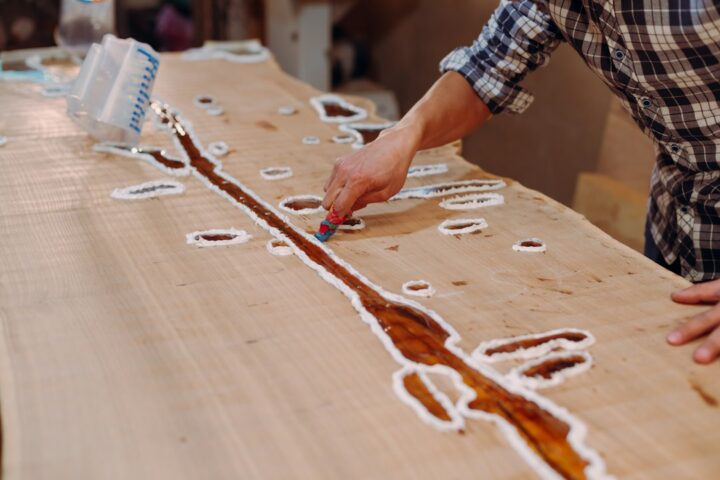
Food Safe Epoxy: What Is Safe for Boards & Tables
Resin cutting boards, charcuterie platters, coasters and river-style serving trays look stunning, so it is no surprise that “is epoxy food safe?” is one of the most common questions we hear. The honest answer is: it depends on the product, how completely it has cured, and how the surface will be used. A food safe epoxy is one whose fully cured film meets food-contact rules for incidental contact, but even the best formula is not designed to be chopped on with a knife. This guide explains what the claims mean, how to get a safe cure, and which surfaces should never be used for cutting.
For the bigger picture on resin chemistry and choosing a system, see our epoxy resin guide, which this article sits under.
What “food safe epoxy” actually means
Liquid epoxy resin and hardener are never food safe. Before curing, both parts are skin and respiratory sensitisers. Food safety only applies to the fully cured solid, when the resin and hardener have reacted into an inert plastic. A manufacturer calling its product “food safe”, “food grade” or “food contact compliant” is typically saying that, once cured as directed, the material meets a recognised standard for contact with food.
Look out for vague wording. “Non-toxic when cured” is not the same as a food-contact compliance statement. A reputable product will name the regulation it complies with and the conditions (cure time, temperature, type of contact) under which that holds true.
The rules: FDA and UK/EU food contact
United States
In the US, epoxy coatings that touch food are covered by the FDA’s food additive regulations, chiefly the rule on resinous and polymeric coatings. It lists the permitted epoxy resin types, hardeners and additives, and sets extraction limits. Many craft resins claim compliance with this section for “incidental” or repeated contact, usually after a stated cure period.
UK and EU
In the UK and EU, materials in contact with food must not transfer constituents to food in quantities that could endanger health or change the food unacceptably. Plastics have their own detailed rules on permitted substances and migration testing. A good product sold in the UK should state its compliance with food contact legislation or provide a declaration of compliance on request.
Either way, compliance is tested on properly cured material under defined conditions. If you under-mix, measure wrongly or cure in a cold room, the claim no longer applies to your piece.
Getting a full cure: the part you control
Most food-safety failures come down to incomplete cure, not the product. Follow these steps:
- Measure precisely. Use the exact ratio by volume or weight given on the label. Extra hardener does not speed curing; it leaves unreacted chemicals. Our guide to two part epoxy explains why ratios matter.
- Mix thoroughly. Stir slowly for 3–5 minutes, scraping the sides and bottom. Transferring to a second cup and mixing again helps avoid soft, sticky spots.
- Keep it warm. Most resins need roughly 20–25°C during curing. Cold workshops can leave a surface that feels hard but is not fully cross-linked.
- Wait the full time. Touch-dry is not cured. Many food-contact claims require 7 days or more at room temperature, and some specify up to 30 days.
- Check for smell and tack. A cured surface should have no odour and no tackiness. If it does, do not use it for food.
Mixing and curing guidance for wood projects is covered in more depth in our wood epoxy guide.
Surfaces that should not be cut on
Even a fully compliant food safe epoxy resin is a coating, not a chopping surface. Knife cuts create grooves that trap bacteria, are hard to clean and can lift fine particles of resin into food. Practical rules:
- Resin and wood cutting boards: fine for serving, but cut only on the bare wood side or areas without resin. Many makers keep resin to the edges and inlays and leave the working face as solid hardwood finished with food-safe oil.
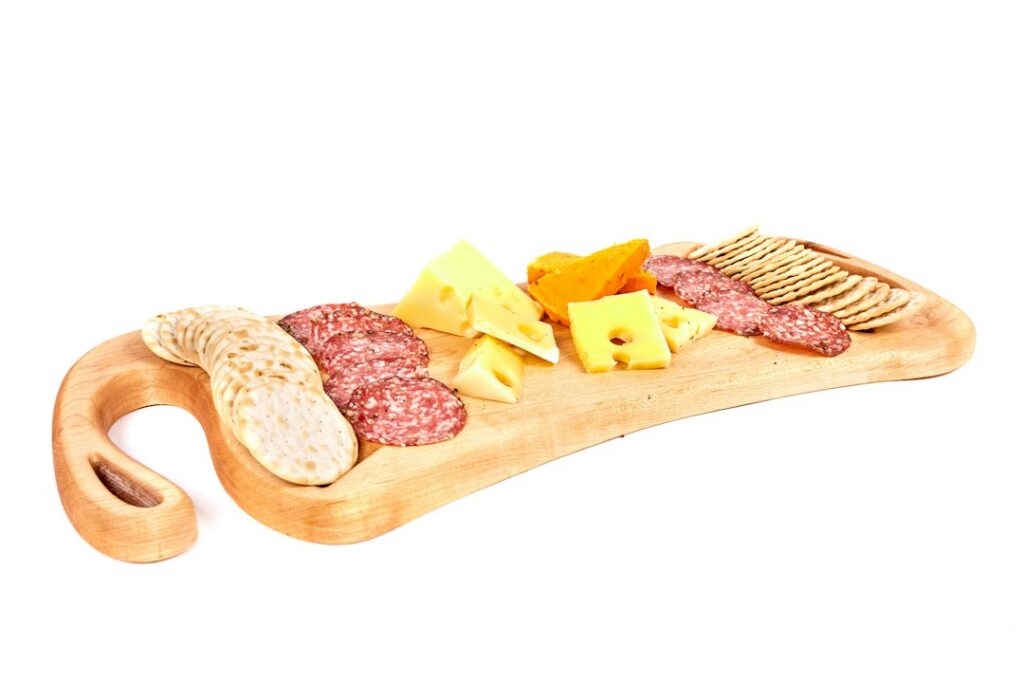
- Charcuterie and cheese boards: suitable for serving dry and cool foods. Slice on a separate board.
- Coasters, trays and table tops: incidental contact only, such as a sandwich resting briefly on the surface.
- Avoid heat: most epoxy softens at around 50–60°C. Hot pans, boiling liquids and dishwashers can damage the surface and are outside most food-contact claims.
- Avoid long soaking: do not store acidic or oily foods on resin for long periods.
Food safe resin for tables and countertops
Dining tables and kitchen counters are mainly about incidental contact: plates, cutlery and the odd crumb. A properly cured table-top or bar-top epoxy is generally well suited to this, but it still shouldn’t be used as a chopping or pastry surface without a board. See our guides to table top epoxy and epoxy countertops for coating thicknesses and heat-resistance details.
What to look for when buying
Rather than chasing a single “best” product, check the label and technical data sheet for these points:
| Check | What good looks like |
|---|---|
| Compliance statement | Names a specific standard (e.g. FDA 21 CFR 175.300 or UK/EU food contact rules) |
| Cure conditions | States temperature and days required before food contact |
| Type of contact | Clarifies incidental vs repeated contact and food types |
| Safety data sheet | Readily available, with clear PPE guidance |
| Solvent-free formula | 100% solids, low odour, no added solvents |
| Clarity and UV stability | Important for visible pieces; see our clear epoxy resin guide |
If a label cites the US rule, you can check what it covers in the published text of 21 CFR 175.300 on resinous and polymeric coatings, which lists the permitted epoxy resins and hardeners.
Be wary of food safety claims on fast-cure, deep-pour or UV-curing products unless the manufacturer explicitly supports them for food contact. UV resin in particular often cures incompletely in thicker sections; our UV resin guide covers its limitations.
Safety while working
Uncured resin is the hazard. Wear nitrile gloves, eye protection and long sleeves, ventilate the room, and use a respirator with organic vapour cartridges in enclosed spaces or when sanding. Repeated skin contact can cause lasting allergic sensitisation. Sand cured epoxy only with dust extraction and a dust mask.
Caring for resin serving pieces
- Hand wash in warm, soapy water and dry straight away.
- Never put them in the dishwasher or microwave.
- Re-oil exposed wood with food-safe mineral oil or board butter every few weeks.
- Restore dulled gloss with fine polishing; see how to polish epoxy resin.
Watch it being made
Watch our first light-up resin table being made in the workshop, with dragons and creatures appearing in the resin art, and the colours, pours and finishing shown step by step.
Resin Art Dragons and creatures in resin art table My First Light-Up Resin Table. More builds on the Go Bespoke YouTube channel.
Frequently asked questions
Is epoxy resin food safe?
Only when it is a product formulated and tested for food contact and has been fully cured according to the label. Uncured or partly cured resin is not food safe.
Is food grade epoxy safe for cutting boards?
It is fine for serving, but you should not cut directly on resin. Knife marks harbour bacteria and can release particles. Cut on the bare wood areas or use a separate board.
How long does epoxy take to become food safe?
Typically 7 days at room temperature, though some products specify longer. Check the technical data sheet and keep the piece warm while it cures.
Is resin food safe once dry?
“Dry to the touch” is not the same as fully cured. Food safety depends on the specific product and on a complete cure, with no smell or tackiness remaining.
Can I put hot food on an epoxy board?
Avoid it. Most epoxies soften well below cooking temperatures, and heat is generally outside food-contact claims. Use a trivet or a wooden board.
Planning a bespoke resin serving board, kitchen island or dining table? Get in touch to discuss a commission built with food-contact use in mind.