Epoxy Resin Conference Table: Boardroom River Tables
Updated 17 October 2026
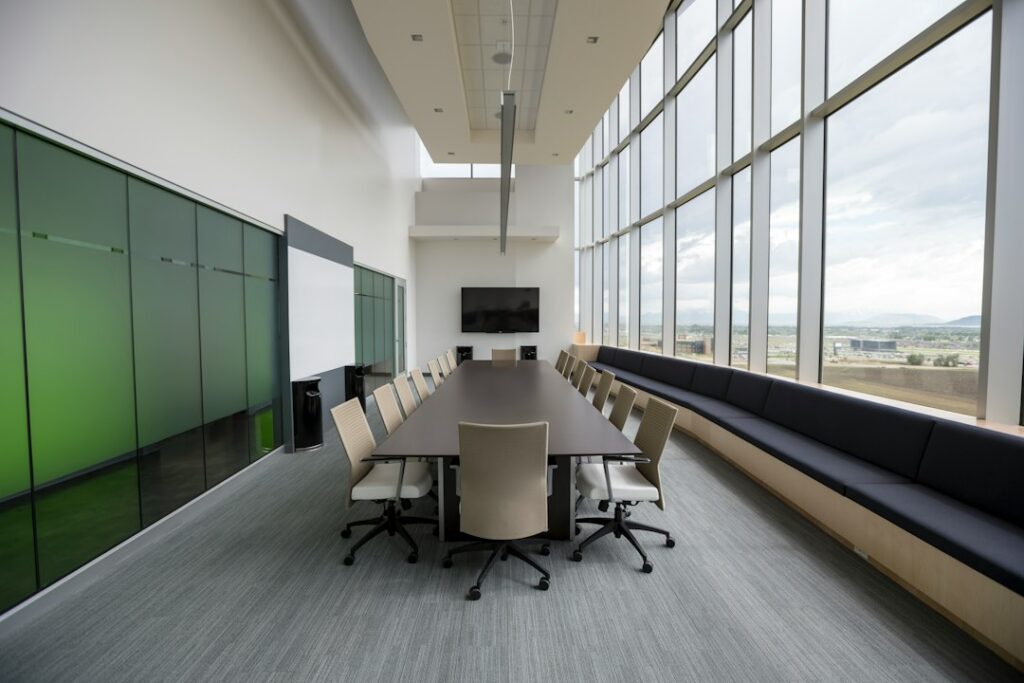
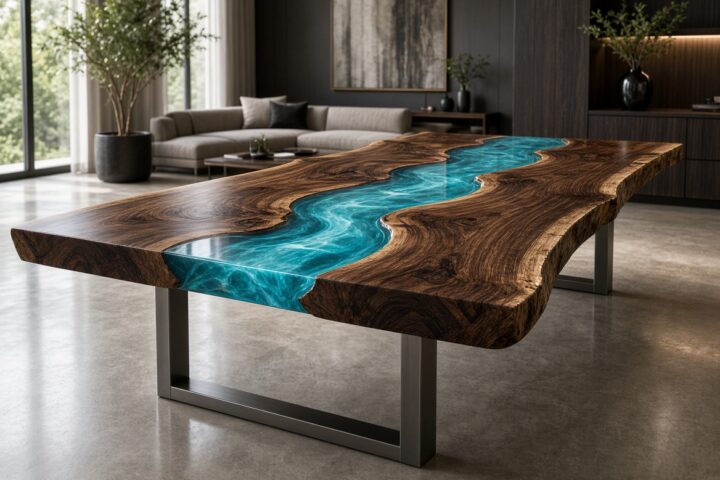
A boardroom table is the one piece of furniture every visitor sits at, and it quietly says a lot about the business around it. An epoxy resin conference table combines solid timber slabs with a cast resin “river” or inlay, so you get the warmth of real wood with a glassy, durable centre that nobody else’s meeting room will have. This guide covers how to size one for your team, how to plan power and cable management, what the build involves and how lead times and commissions usually work.
If you are new to the style, our complete guide to epoxy tables explains the basics of resin and wood construction. Here we focus on what changes when the table has to seat eight, twelve or twenty people and survive daily use in an office.
Why choose an epoxy resin conference table?
Most conference tables are veneered board or laminate. They are practical but forgettable. A resin and timber top gives a business something closer to a piece of commissioned art, while still being hard-wearing enough for laptops, coffee cups and the occasional dragged chair.
- Brand presence: resin can be tinted to echo company colours, from deep navy to emerald or smoky grey, without painting the wood.
- Durability: a properly cured and finished top resists everyday scratches and spills better than many oiled solid-wood surfaces.
- Repairability: light scuffs can be sanded and polished back rather than the top being replaced.
- Story value: a slab from a particular species or region gives clients something to talk about before the meeting starts.
The look sits somewhere between a classic wood and resin table and a statement sculpture. The trick is keeping it professional: calmer resin colours, straight outer edges and a satin finish usually suit a boardroom better than a bright, high-gloss river.
Sizing an epoxy conference table by number of seats
Getting the size right matters more than any design choice. A common rule of thumb is to allow roughly 60–75 cm (24–30 in) of table edge per person, plus around 100–120 cm (40–48 in) of clear space behind each chair so people can stand and move around. The table below gives typical starting points for a rectangular top.
| Seats | Typical length | Typical width | Room size needed (approx.) |
|---|---|---|---|
| 6 | 1.8–2.1 m (6–7 ft) | 0.9–1.0 m | 4.0 × 3.2 m |
| 8 | 2.4 m (8 ft) | 1.0–1.1 m | 4.6 × 3.4 m |
| 10 | 3.0 m (10 ft) | 1.1–1.2 m | 5.2 × 3.5 m |
| 12 | 3.6 m (12 ft) | 1.2 m | 5.8 × 3.6 m |
| 14–16 | 4.2–4.8 m | 1.2–1.3 m | 6.5–7.0 × 3.7 m |
Widths over about 1.2 m start to make cross-table conversation awkward and screens harder to see. For very long tables, think about a boat shape (wider in the middle, narrower at the ends) or a two-piece top joined on a hidden seam, which also makes delivery through lifts and stairwells far easier.
Thickness and weight
Most resin conference tops are 40–60 mm (1.5–2.5 in) thick. A 3 m hardwood and resin top can easily weigh 150–250 kg, so the base, the floor and the delivery route all need checking early. Splitting the top into sections, or using a lighter timber such as ash rather than oak, keeps things manageable.
Wood, resin and design options
Popular timbers for an epoxy river conference table include walnut, oak, elm and ash. Darker woods like those in our walnut epoxy tables pair well with smoked or clear resin for a restrained executive feel, while oak and elm suit lighter, Scandinavian-style offices.
Design layouts generally fall into three groups:
- Central river: two book-matched slabs with a resin channel running the full length, the classic river table look scaled up.
- Edge rivers or inlays: resin along the outer edges or in cracks and knots, leaving a mostly solid-wood surface that reads as more traditional.
- Multi-slab mosaic: several narrower boards with resin joints, useful when single wide slabs of the right length are hard to source. Our guide to choosing live edge slabs explains what to look for in grain, moisture and defects.
Resin colour should be tested against the room’s lighting. Translucent tints change a lot between daylight and office LEDs, so ask for a sample block before committing.
Cable management and technology
A modern meeting room table is also a power and data hub. Planning this before the resin is poured is essential, because cutting into a finished top is risky and can crack the resin.
- Pop-up or flip-top power modules: recessed units with sockets, USB-C and HDMI that sit flush when closed. The cut-outs are machined into the wood sections, not the resin, to avoid stress cracks.
- Cable trays and spines: steel trays fixed under the top carry cables to a hollow leg or central column so nothing trails across the floor.
- Floor boxes: if the room has floor boxes, the base should be positioned so a leg or column lands over them.
- Integrated lighting: for something truly distinctive, LED strips or fibre optics can be cast into the resin. Our LED epoxy table guide covers how the electronics are hidden and powered.
Share your AV plan and module positions with the maker at the design stage, along with the exact product dimensions, so the openings can be routed accurately.
How an epoxy resin conference table is built
The process is the same as for any large river table, just on a bigger scale and with tighter tolerances:
- Slab selection and drying: timber should be dried to roughly 8–12% moisture content to suit indoor heated offices.
- Flattening and stabilising: slabs are flattened, cracks filled and bark removed, then the edges are sealed with a thin coat of resin to stop air bubbles rising into the pour.
- Mould and pour: a sealed mould is built and a deep pour resin is cast in one or several layers, depending on its maximum pour depth. Large rivers can need tens of litres; our epoxy quantity calculator shows how volumes add up.
- Curing: deep pour resins typically need 3–7 days at around 20–24 °C before demoulding, and longer before full hardness.
- Machining and finishing: the top is flattened, cut to size, routed for power modules, then sanded through the grits and finished with a hardwax oil, polyurethane or a polished resin coat.
- Base fitting: steel or timber bases are fixed with slotted brackets so the wood can move slightly with the seasons.
Seasonal movement is the reason good makers never glue a wide top rigidly to its frame. If you want the science behind it, the US Forest Products Laboratory’s Wood Handbook chapter on moisture content and dimensional change explains how timber shrinks and swells with humidity and how to estimate it for different species.
Costs and lead times
Pricing depends on size, timber, resin volume and technology. As a broad guide, a bespoke 8–10 seat resin conference table typically costs around £5,000–£12,000 ($6,500–$15,000), with larger or lit tables going well beyond that. The resin alone on a big river can run to several hundred pounds or dollars.
Lead times are usually longer than for standard office furniture. Typically allow:
- 1–2 weeks for design, drawings and samples;
- 2–4 weeks to source and prepare slabs (longer if they need further drying);
- 4–8 weeks for pouring, curing, machining and finishing;
- plus delivery and installation, which may need a team of four or more people.
For a fit-out with a fixed move-in date, start the conversation at least three months ahead. If you need something sooner, ask whether any finished pieces are available; our page on river tables for sale explains what to check when buying ready-made.
Commissioning tips for businesses
- Measure the room, door widths, lift dimensions and stairwells before you finalise the size.
- Agree a written spec covering timber, resin colour, finish, thickness, base style and module positions.
- Ask about care: most finishes just need a damp cloth and mild detergent, with coasters for hot drinks.
- Check the finish suits heavy use. A hard-wearing lacquer or resin top coat is easier to maintain in a busy meeting room than a natural oil.
- Consider matching pieces, such as a side console or reception desk, from the same slabs.
The same considerations apply to large home dining tables, so our guide to custom epoxy tables is also worth a read.
Watch it being made
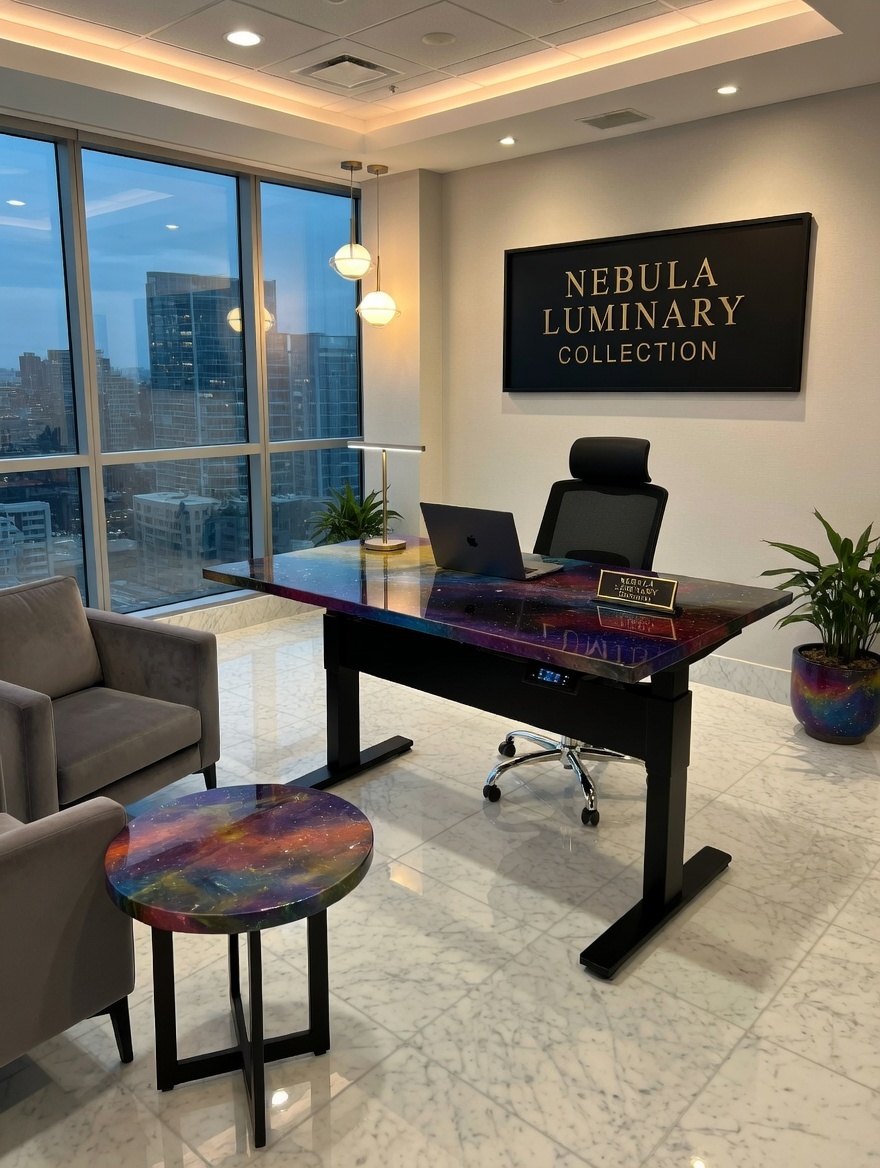
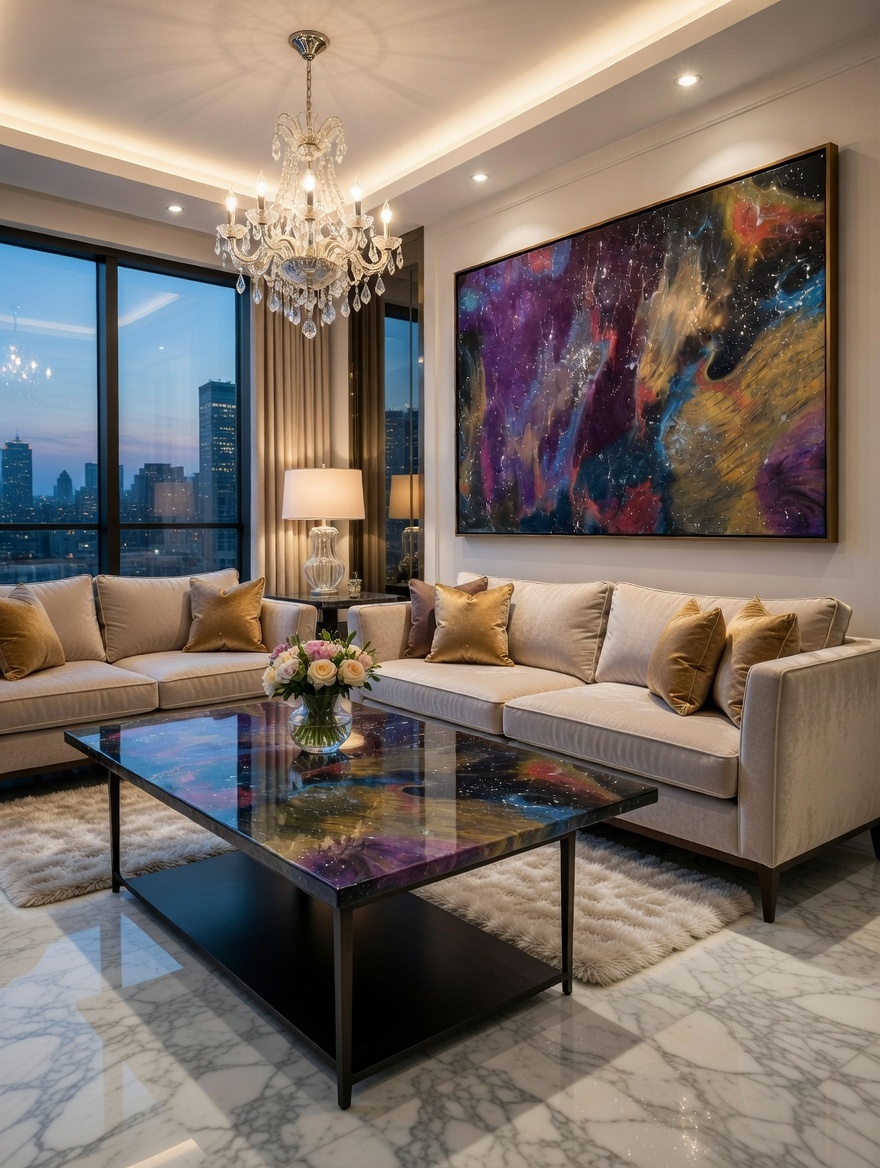
See one of our tables come together in the workshop: a nebula resin top with fibre optic stars, from the first pour to the lights going on.
Resin art nebula resin table with fibre optic art. More builds on the Go Bespoke YouTube channel.
Frequently asked questions
How big should a 10-person conference table be?
Typically around 3 m (10 ft) long and 1.1–1.2 m wide, in a room of roughly 5.2 × 3.5 m so there is space to pull chairs out and walk behind them.
Is a resin conference table durable enough for office use?
Yes, if it is built with a quality resin, fully cured and given a hard-wearing finish. Like any table it can be scratched by sharp objects, but light marks can usually be sanded and polished out.
Can power sockets be built into an epoxy conference table?
Yes. Flush pop-up modules and cable trays are routed into the timber sections during the build. It is best to decide on them before the top is finished.
How long does it take to make an epoxy resin conference table?
Typically 8–14 weeks from design approval to delivery, depending on slab availability, size and how many resin layers are needed.
Will the resin yellow in a sunny boardroom?
All epoxies can yellow slowly under strong UV. Choosing a UV-stabilised resin, a UV-resistant top coat and tinted rather than water-clear resin all help keep it looking fresh.
Planning a boardroom or meeting space? Go Bespoke designs and builds resin and timber tables in our London workshop. Get in touch about a bespoke commission and we can talk through sizes, timbers and technology for your room.